


Baffin Island Expedition: Akshayuk Pass Traverse
Baffin Island Expedition: Akshayuk Pass Traverse
Cross one of the most iconic Arctic routes on Earth, moving through glaciers, granite peaks, and vast northern wilderness
Fully guided from Ottawa, including Arctic flights and logistics
*Displayed in CAD. Approximate USD shown for reference.
Expedition Log
Built on everything we’ve learned guiding in the Arctic and Yukon
Refined through real expedition experience in remote northern terrain.
Departure Date
July 10 to 30, 2027
Book this dateOnly 4 adventurers can still join this departure.
You’ll be redirected to our secure Square checkout to pay the 60% deposit, which confirms your spot on the expedition. Because this expedition requires significant advance planning, logistics, and preparation, the remaining 40% is due 90 days before departure. A confirmation email with next steps and preparation details will follow.
Know before you go
A true Arctic backpacking expedition
This is a self-supported journey through one of the most remote valleys in Canada. Once we enter Auyuittuq National Park, we carry everything we need and move entirely on foot through the heart of Akshayuk Pass.
There are no marked trails or fixed infrastructure along the route. We travel across tundra, rocky valley floors, glacial outwash plains and braided river systems, establishing camp in the wild each night.
The terrain is non-technical and does not involve climbing or glacier travel, but it is physically demanding. You should arrive prepared for consecutive days carrying a full backpack over uneven ground, with river crossings, changing weather and little natural shelter.
Conditions in the Arctic can shift quickly. Wind, rain, temperature changes and river levels all influence the pace and flow of the expedition, so flexibility and good decision-making are part of the experience.
Before entering the backcountry, we spend time in Pangnirtung to settle in, organize gear and connect with the community. This includes a cultural introduction, a fishing experience with a local partner and a full-day hike to Mount Duval.
Step into one of Canada’s wildest landscapes: a fully guided Arctic backpacking expedition through Auyuittuq National Park on Baffin Island.
Our journey begins in Pangnirtung, a small Inuit community on Baffin Island. Before committing to the traverse, we take time to settle into the North, organize our gear and get a first sense of the land and the people who live here.
This opening phase is intentional. We spend time in the community, take part in a fishing experience with a local partner and head out for a full-day hike to Mount Duval. It gives the group a chance to move together, prepare for the days ahead and step gradually into the environment.
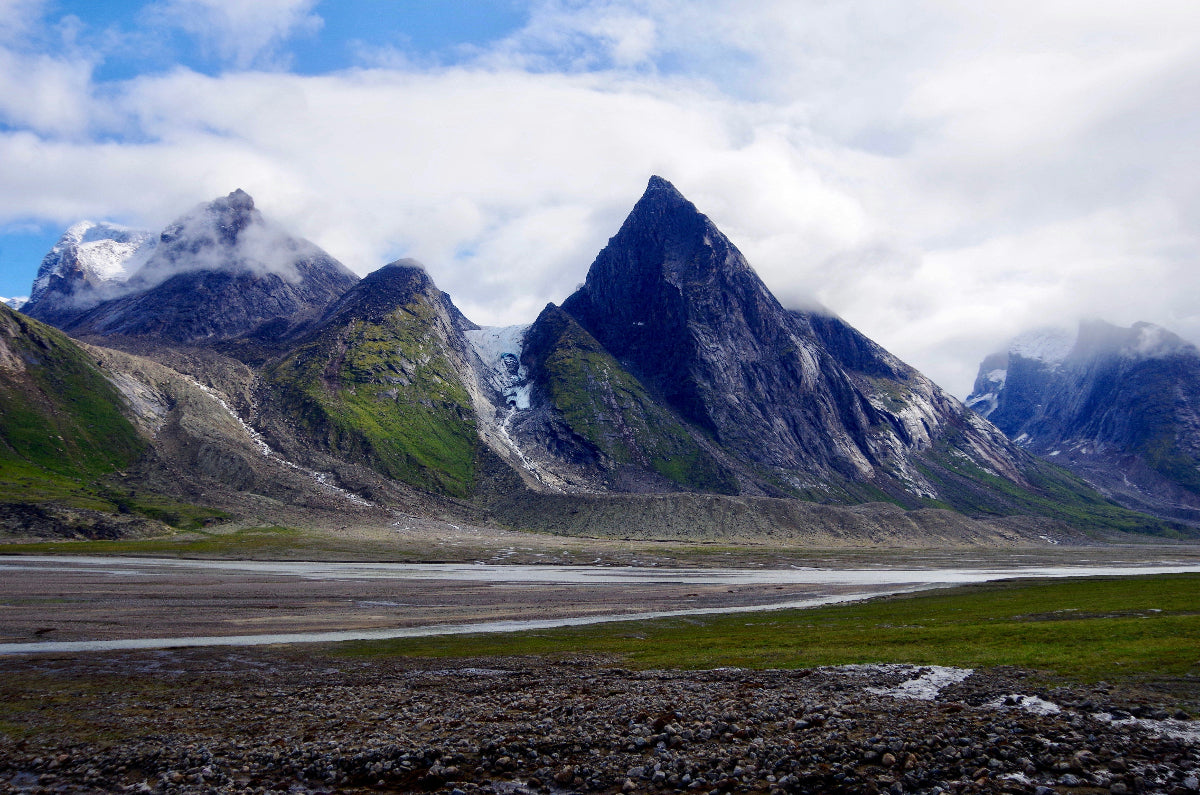
From Pangnirtung, we travel by boat to the edge of Auyuittuq National Park and begin our crossing of Akshayuk Pass. This is a place of immense granite walls, wide tundra valleys, icefields and constantly changing rivers.
For approximately 12 days, we move entirely on foot through the valley, carrying our personal equipment and a share of the group gear. Each evening, we establish camp in a new wild location and prepare our meals in the field.
There are no marked trails here. Travel follows natural lines through the landscape — across open tundra, rocky valley floors, glacial outwash terrain and braided river systems. The route is non-technical, but requires steady endurance, balance and the ability to move efficiently over rough ground with a full pack.
Surrounded by massive granite faces and glaciers, we travel beneath iconic peaks like Mount Thor and Mount Asgard — not as climbing objectives, but as part of the extraordinary environment we move through.
Days are structured but never rigid. Some may be long and steady, while others are shaped by river levels, weather or the terrain ahead. We build flexibility into the journey so we can adapt to the Arctic rather than push against it.
Once we enter the valley, we are fully immersed in it. The experience comes from moving through the landscape as a team, making good decisions together and allowing the rhythm of the place to set the pace.
After completing the traverse, we hike out of the valley and return by boat to Qikiktarjuaq. From there, we fly back to Pangnirtung before returning to Ottawa together, closing the expedition as a group.
This is not a trip through the Arctic from a distance. It is a chance to move through it slowly, carry what you need and experience one of Canada’s great wilderness corridors on foot.
- Itinerary
Day 1 — Arrival in Ottawa
Day 1 — Arrival in Ottawa
The expedition begins in Ottawa.
We meet as a group in the afternoon or evening, depending on arrival times. This first day is about settling in, meeting the team, and stepping into the mindset of the expedition ahead.
We’ll run through a full briefing, check gear together, and make sure everything is dialed before heading North. It’s a relaxed start, but an important one — this is where the expedition starts to feel real.
We stay in private accommodation in Ottawa, with space to lay out gear, go through final preparations, and get to know the team.
There’s no better way to kick things off than sharing a first meal together — the kind of moment where it all starts to sink in that something big is about to begin.
Day 2 — Travel to Pangnirtung
Day 2 — Travel to Pangnirtung
We leave Ottawa early and start heading north.
Flights take us through Iqaluit and onward to Pangnirtung — a small Arctic community set between mountains and the sea.
You’ll notice it pretty quickly: no more trees, bigger landscapes, and everything feels a bit more remote.
By the time we land, it’s clear — we’re in the Arctic now.
We head to camp, sort gear, and take some time to settle in. Nothing too rushed, just getting organized and used to the environment.
First night out here, first proper feel of what’s coming.
Day 3 — Pangnirtung & Cultural Experience
Day 3 — Pangnirtung & Cultural Experience
We spend the day getting a better feel for Pangnirtung and the environment we’re about to head into.
We connect with a local partner and head out for a fishing experience on the fjord. It’s a different way to experience the landscape, and a chance to learn more about life in the North before heading into the backcountry.
And yes — this is also where we find out who in the group actually knows how to fish.
The rest of the day is kept flexible. Time to organize gear, move at a slower pace, and settle into the rhythm up here.
Tomorrow we get the legs moving.
Day 4 — Mount Duval
Day 4 — Mount Duval
Today we head out for our first proper day hike, making our way up Mount Duval.
The route covers approximately 8.5 km with around 695 m of elevation gain — a solid effort and a good way to get the legs moving before the expedition begins.
As we gain height, views open up over Pangnirtung Fiord and the surrounding mountains. It’s a strong first introduction to the scale of the landscape we’re about to enter.
No heavy packs yet — just moving, getting comfortable on the terrain, and enjoying being out there.
Back at camp, we go through final preparations, organize gear, and pack everything down for the next day.
Tomorrow, we leave town behind.
Days 5–16 — Akshayuk Pass Traverse
Days 5–16 — Akshayuk Pass Traverse
We leave Pangnirtung by boat and are dropped off at the edge of Auyuittuq National Park.
From here, the traverse begins.
Over the next 12 days, we move on foot through the Akshayuk Pass, carrying everything we need and establishing camp along the way.
There are no marked trails. Travel follows natural lines through the landscape — across tundra, glacial outwash plains, and braided river systems. Progress depends on terrain, river levels, and weather.
Days are steady and consistent. Some longer, some shorter, depending on conditions. We move as a team, finding a rhythm that works for the group and adapting as needed.
Along the way, we pass landmarks like Crater Lake, cross the Arctic Circle, and move through sections of the valley marked by massive granite walls and powerful waterfalls, including Schwarzenbach Falls. Peaks like Mount Thor and Mount Asgard rise around us — not as objectives, but as part of the landscape we move through.
Life becomes simple out here. Walk, eat, set up camp, repeat.
And yes — at some point, everyone starts questioning at least one item they decided to bring.
By the end of the traverse, the routine feels natural, and the group has settled into it completely.
Day 17–18 — Exit & Qikiqtarjuaq
Day 17–18 — Exit & Qikiqtarjuaq
We reach the end of the traverse and make our way out of the valley, stepping back toward the coast after days deep in the backcountry.
From there, we jump on a boat and head to Qikiqtarjuaq — a small Arctic community right on the ocean, surrounded by wild coastline, floating ice, and big open space.
After days of carrying everything on our backs, this feels like a proper reset. A roof overhead, a shower, and that first moment where you realize: yeah… we actually just did that.
We stay here for the night, with a built-in buffer day in place.
This is part of the expedition. Boats, weather, Arctic logistics — they don’t run on tight timelines, and we don’t try to force them. The extra day gives us room to move without pressure.
And honestly, after 12 days out there, no one’s in a rush.
Day 19 — Return to Pangnirtung & Celebration
Day 19 — Return to Pangnirtung & Celebration
We make our way back to Pangnirtung.
Back at camp, we unpack, dry gear, and get everything ready for the journey south the next day, while slowly settling back into town after nearly two weeks out in the valley.
That evening, we head out for a proper restaurant dinner, where real food, full plates, and a relaxed setting feel like a pretty solid reward after what we’ve just done.
No camp stove, no rationing, no freeze-dried meals — just sitting down together, taking it in, and enjoying a well-earned night out.
And after 12 days out there, ordering more than you need suddenly feels completely reasonable.
Day 20 — Return to Ottawa
Day 20 — Return to Ottawa
We leave Pangnirtung and begin the journey back south.
Flights take us through Iqaluit and onward to Ottawa, gradually moving from Arctic landscapes back into more familiar surroundings.
It’s a long travel day, but an easy one. Packs are lighter, legs get a break, and there’s time to look back on everything we’ve just been part of.
Back in Ottawa, we spend one final night together as a group — a relaxed evening to unwind, share a few more stories, and close out the expedition properly.
Day 21 — Departure Day
Day 21 — Departure Day
Departure day from Ottawa.
Flights home, back to normal life — or at least something close to it.
Age requirements
Age requirements
The minimum age to book with YuSquatch Mt. Adventures is 18 years old unless accompanied with a legal guardian on the tour.
Cancellation Policy
Cancellation Policy
This expedition follows a custom payment and cancellation policy due to the extensive advance planning, permits, logistics, transportation coordination, and preparation required for remote Arctic travel.
Cancellation Terms
- The initial 20% booking payment is non-refundable once your spot is confirmed.
- Cancellations made before July 1, 2026:
20% of the total trip cost is non-refundable - Cancellations made after July 1, 2026 and more than 3 months before departure:
60% of the total trip cost is non-refundable - Cancellations made within 3 months of departure:
100% of the total trip cost is non-refundable
Please Note
- This expedition involves remote Arctic logistics, local partners, permits, transport coordination, and significant advance preparation. For this reason, the standard Yusquatch Mountain Adventures cancellation policy does not apply.
- Yusquatch Mountain Adventures reserves the right to modify, delay, reroute, or cancel the expedition when deemed necessary for safety, environmental, weather, operational, transportation, permitting, or logistical reasons.
- Refunds are not guaranteed for itinerary changes, weather events, transportation delays, missed flights, government restrictions, natural disasters, community access limitations, or other circumstances outside of our control.
- If a participant voluntarily leaves the expedition early, no refund will be provided for unused portions of the trip.
- We strongly recommend purchasing comprehensive travel insurance, including:
trip cancellation,
trip interruption,
emergency medical,
evacuation,
and travel delay coverage.


Expedition Notice
This expedition takes place in a very remote Arctic environment where weather and logistics can affect travel timelines. Delays are part of operating in the North.
We strongly recommend allowing flexibility in your plans and not scheduling important commitments for at least a week after the trip.
-
What makes this different
We take care of the entire journey from the moment you arrive in Ottawa.
- Group travel to Pangnirtung
- All logistics in the North
- Boat access to and from the park
- Fully guided expedition throughout
You don’t need to coordinate flights into remote Arctic communities or navigate complex logistics. That part is handled.
Your focus is on preparing for the expedition itself.
-
Who this is for
This expedition is designed for those who:
- Have prior multi-day backpacking experience
- Are comfortable carrying a full pack for consecutive days
- Are open to variable conditions and remote travel
- Want to experience the Arctic in a raw and immersive way
A strong mindset, adaptability, and team awareness are just as important as physical fitness.
-
Guide to guest ratio
We operate with a 1:4 guide-to-guest ratio.
This allows for a high level of support in the field, flexibility in decision-making, and strong group awareness throughout the expedition.
In a remote environment like this, having multiple experienced guides makes a real difference, both in how the group moves and how decisions are made day to day.
-
What's included
- Return flights from Ottawa to Pangnirtung
- Boat transfers into and out of Auyuittuq National Park
- 2 nights accommodation in Ottawa (first and last night of the trip)
- All remaining nights camping in the backcountry
- Fully guided expedition with a small group (max 8 participants)
- All meals during the expedition, except one restaurant dinner in Pangnirtung
- Group camping gear including tents and cooking equipment
- Satellite communication devices (sat phone, GPS, inReach)
- Bear safety equipment and protocols for travel in polar bear habitat
- Cultural experiences in Pangnirtung
-
What's not included
- Travel to and from Ottawa
- Personal travel insurance (mandatory)
- Sleeping bag and sleeping pad (available for rent)
- Personal backpacking gear and clothing
- One restaurant dinner in Pangnirtung
- Gratuities for guides and local partners
Support & Safety
This expedition is led by ACMG-certified guides with experience in remote northern environments. Guides hold advanced 80-hour Wilderness First Aid certification, and we travel with satellite communication devices (sat phone and inReach), GPS navigation, and comprehensive first-aid kits to stay connected and prepared throughout the journey.
Travel in Auyuittuq National Park is very remote. We operate with clear safety protocols for river crossings, terrain management, and travel in polar bear habitat, including appropriate bear safety equipment.
We work with trusted local partners for transportation into and out of the park, and maintain contact with local operators who can be called upon if needed in case of emergencies.
Daily decisions are made based on conditions, group dynamics, and experience in the field. Weather, terrain, and logistics are all factored into how we move and where we camp.
You’ll receive detailed pre-trip preparation guidance, including gear recommendations and packing support, so you arrive ready for the expedition.
From the first day in Ottawa to the final return south, you’re supported every step of the way.